The Real Deal
Just how legit was this test???
This article is the contribution of a Bake-off participant who wishes to remain anonymous, but has contributed greatly to the realistic interpretation of the test results.
Quote:
Jim:
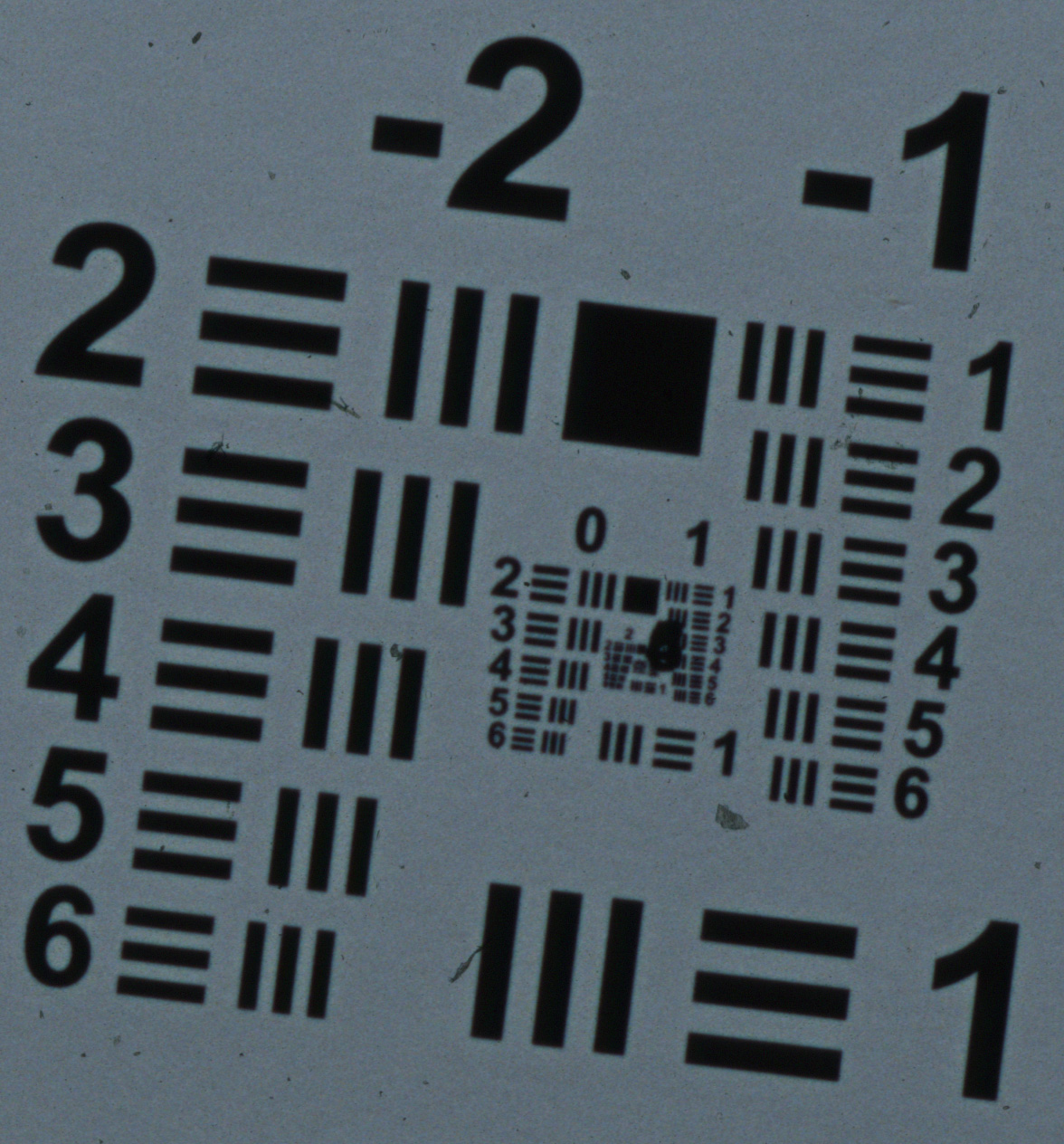
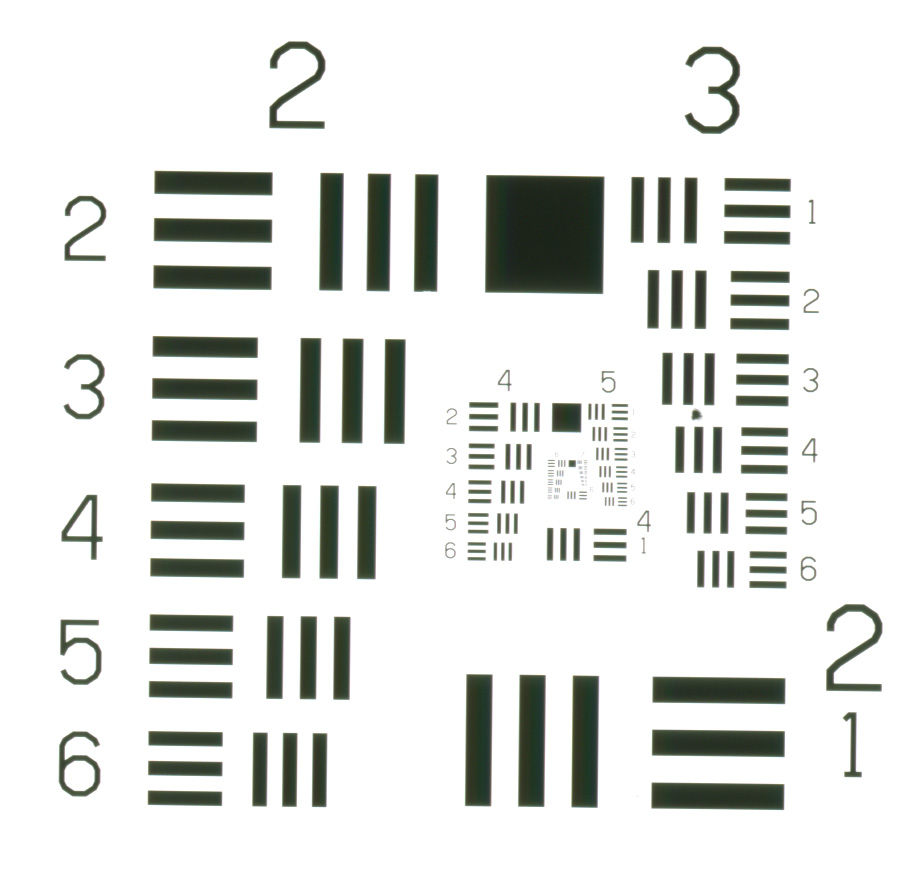
I was never able to find a microscope I trust, but I was able to obtain an high resolution slide, with the patterns in metal deposited on glass. This slide has tri-bars from 1 lp/mm to 228 lp/mm. I’m including snips from scans of your test slide and the new one I have, at approximately the same scale. Each was scanned at 5400 lines/inch with a Minolta Dimage Scan Elite 5400 using manual focus, and the software Dimage Scan Utility Ver. 1.1, and was uncorrected in any way other than cropping and flipping or rotating using Photoshop CS. The bars on the new slide are unfortunately aligned with the cardinal axes, rather than inclined as yours were, so there is a noticeable aliasing impact on reading the limiting resolution. You might be able to run it through your software if you rotate it digitally first, although that leaves something to be desired, of course.
On the new target the resolution of the largest pattern in each group is 2 to the Nth power line pairs per millimeter, where N is the group number. Thus pattern 1 in group 0 is 1 lp/mm. For comparison, I believe the largest pattern on your slide is about 1.55 lp/mm (Group -4, pattern1). For intermediate patterns within a group, they are in steps of .1667. Thus pattern 2 in group 5 would be 2 to the 5.1667, or about 36 lp/mm.
Using these numbers, I make the limiting resolution about Group 6, Pattern 3, or 80 lp/mm with the hi-res slide, and Group 1 pattern 4 with your slide, or 70 lp/mm using this scanner. Because the 80 lp/mm is getting dangerously close to the Nyquist limit of the scanner (106 lp/mm) I think the 50% MTF resolution may show a larger difference. A lot depends on the MTF of the film, processing, and the lens you used, of course.
I think these results indicate that the slide you supplied did not limit the results of the test to any significant extent, with the possible exception of the very best scanners. Even there, the slide was good enough that it would have certainly ranked the scanners correctly, although the absolute resolution numbers may have been impacted. Given that two people measuring two different scanners in their own environment would do well to agree within 10-15%, I think that’s pretty good.
BTW, this slide is available from Edmund Optical as Part No. 38257. See http://www.edmundoptics.com/onlinecatalog/displayproduct.cfm?productID=1790